A Year in Photos

Photography, fiction, and personal essays form my three primary creative outlets. For this blog's first 18 months, I used it primarily for photography. As I've returned to creative writing, I'll use this blog for fiction, too. Sometimes, when reality needs to be discussed more than truth, I write personal essays.

This blog will continue to showcase as many above-average photos as I can muster. Hopefully my written work will be as good or better than the visual. Whichever drew you here -- photographs or fiction, I hope you enjoy both.

Tuesday, March 20, 2012

K-7 Building Photographs, Day Two of Three

This is the second post examining some building photographs from last week -- why they work, why they don't, and how they could have been better.


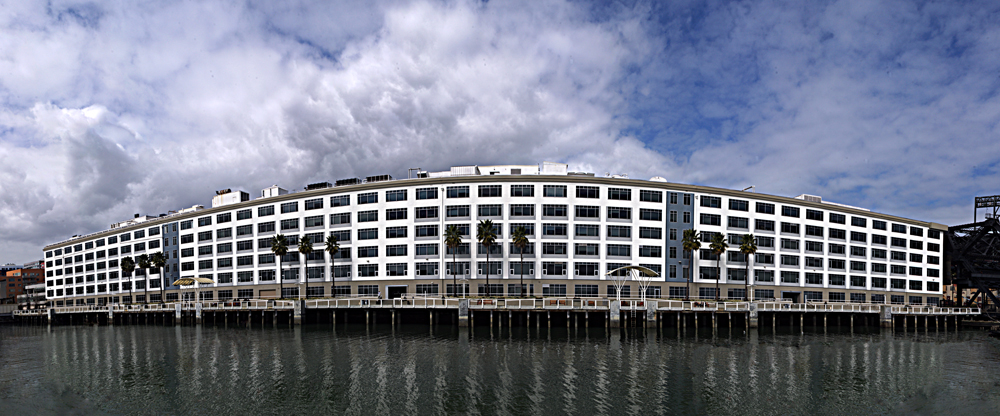
Paragon apartments building, near AT&T Park. Made from 16 or so photos. Corrected with lens correction. Also sharpened. I left a lot of the sky in to add some image drama. It looks vertical, but that's an effect created by the lens distortion filter. The clouds' drama was also amplified by the lens distortion.


A single shot, in-camera HDR. Took three similar shots with different bracketing. Borrowed a better sky from another shot, overlaid it, and reduced the transparency to hide the merge and make the color cast more consistent. Not an exciting shot, but workable. The plants in the foreground are a nuisance which can't be avoided from this perspective.

One nice thing about this shot is the elevated position -- about 25 or 30 feet above the BoA Building's parking lot. This leads us into an important lesson about photographing buildings: When possible, an elevated position balances the perspective better, leading to a higher-quality result.

1- When possible, photograph a building from an elevated position.

Monday, March 19, 2012

Bad Weather, Bad Waves, Great Splashes

Last Tuesday saw some rain and a good deal of wave energy within the bay. As I walked up the Embarcadero, the waves on the rocks and along the piers broke upward with


A sea lion statue by AT&T Park.


A reflection of the Ferry Building. I'd hoped it to be a clean reflection with a couple ripples. It didn't turn out that way.


1/8th exposure, luckily timed so that the trolley began moving late in the exposure, making only part of it blurry.


Sunday, March 18, 2012

K-7 Building Photographs, Day One of Three


I'm not displeased with that photo. It's wildly exaggerated from real life, but I don't find it visually offensive. And the boomerang effect is fairly dramatic. SO first let's ask how this photo came to have this look. The building photographed is here, as seen on Google Maps.. The building is an entire city block long -- along Mission Creek from 3rd to 4th Streets. That answers the question about the boomerang look -- the perspective. Since this building is -- give or take 20 feet -- about 821 feet long, the distance from the building's 'front' is much different than from the wings. Specifically, from the focal center, the building was 261.4 feet from where I took the photo. The right edge was 372.9 feet, the left edge 545.5 feet. You'll notice, now if not already, that I was not centered on the building. That was because of a bum smoking crack where I could have stood to be centered on the building. I decided to let him smoke up in peace.

The lens was my Sigma 35-80mm. On the K-7's APS-C crop sensor, that means the lens, at 35mm, which this shot was taken at, acts as a 52.5mm lens. Clearly there's no way to take this shot from 261 feet out with a 53mm lens. One of the wonderful tools for photographs in the past few years has been Photoshop. A great feature is the photomerge function which takes multiple images, evaluates the content, and glues them into a single image. This was assembled from 39 images -- 3 horizontal rows of 13. The original merged image was 11,000 pixels wide (12 ft., 8 inches at 100%) and has much more of Mission Creek at the bottom. I elected to crop out the water since it detracted from the building composition.

I left my computer to glue the photos together and then balanced the color with automatic color balancing. This helps remove color mismatches between different stitched imaged. It's not perfect sometimes, but did well here. To make the image a bit poppier, I used the unsharp mask sharpening tool (though I don't recall the settings) and that improved contrast and added great detail depth to the clouds. In sum, the process took about 35 minutes, but I was able to do the photomerging in the background.


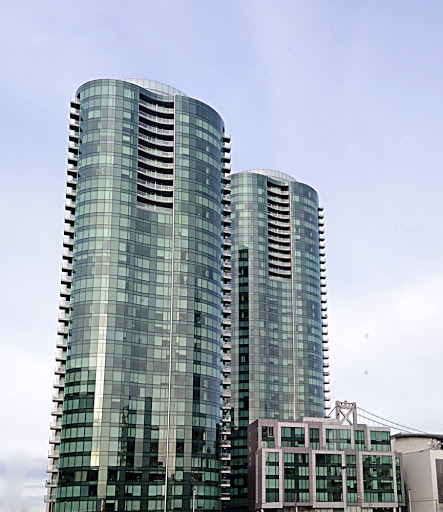
The Infinity Complex. I've photographed this before for this blog but wanted to come back on a sunny day. It's a great looking building designed by Arquitectonica and built by Webcor Builders. You can find it here on Google Maps..

This was created with the same process as above -- photomerging about 44 images to create a basic composition. This is the corrected and cropped image. One difficulty in photographing skyscrapers is that they always appear to recede in image. The lines look parallel in real life because our brain corrects for the perspective. Photographs can't do that, so Photoshop has to. With the Lens Distort filter, I keystoned the image to the maximum amount. THis had only about 25% effect on the image area, however, because whenever I correct lens distortions I increase the canvas size. This allows me to make corrections with no risk of image space loss.

So Photoshop took the merged, flattened, and cropped image and changed the rectangular shape to a keystone shape. A minor crop and the image was close to none. However, I wanted the smaller building on the right to be the vertical and horizontal basis, and it was, but that meant the tower was still leaning far to the right over the building do to perspective and viewing angle.

To correct this, I used the shear filter and made a custom shear shape for the image to follow. Now, it's not perfect -- not even close. The tower has a minor leftward bend near the top. This resulted from the image shear exacerbating the perspective and viewing angle issues. The entire process took about the hours.

Of the two, I'm more partial to the first because to my eye it's a better finished product. Also, the setting strikes me as more dynamic. And it required MUCH less processing. SO here are some lessons learned:

1- Good shots are achieved in-camera and require minimal post-processing.
2- Photos requiring extensive post-processing to become good or usable shots indicate that the shot could have been accomplished with greater quality in-camera.
3- Photoshop can make good photos great, but cannot make bad photos anything.

A Year In Photos -- Week Twelve

This past week was rainy and miserable with constant drizzle and intermittent showers. So I had few opportunities to get out and shoot photos. In fact, I only got out three days. So I'll still have five posts this week, but three of the days will only feature one or two shots and a discussion on how I achieved those shots. Without delay, let's take a look at what some of what this week holds:


With the color images, for those and more we'll discuss how they were achieved and then have a candid examination of why they work and don't work and where they succeed and fail. An artist needs to be their own harshest judge. No one else will be totally honest. Anyone commenting on an artist's work will invariably filter their views through their feelings about the artist and his work.

This week also has an exciting and diver lineup of cameras and films.

Monday: Canon AE-1 (4120937), Canon FD 50mm (4229124), Kodak Plus-X 125 ISO, and a yellow Nikkor filter to bump contrast a bit. Since I only own the one Canon FD lens, I need to be selective in the films I use with it if I plan to go the whole year and both no repeat any film and use it a decent amount. Since I don't think Plus-X can be bought bulk, I don't use it often. And that's unfortunate since it's one of my favorite films.

Tuesday: Pentax KX (8390811), Pentax-M 50mm (3165867), Foma 100 film, and a red filter. I haven't used this KX yet. I bought it in 'great' shape used, but it arrived with a smear in the viewfinder. I haven't yet taken it apart to clean it or see if it can't be cleaned. So that's frustrating and may complicate my photography on Tuesday.

Wednesday: Nikon F3 (1635441), Nikkor-Q 135mm (885501), Tmax 400 ISO, and a green filter. I've had the F3 sitting with a roll of Tmax, 30 exposures, with five frames shot for about a month. So I'm going to finish the roll and open the F3 up to have some Efke or Adox in the coming weeks. Why a green filter? No idea. Gut feeling.

Thursday: Nikon Nikkormat FTN (3634551), Nikkor-Zoom 43-86mm (506282), Ilford Delta 100, and no filter. I've never used Ilford Delta 100 in a 35mm camera. As is my standard policy with new films: no filter. I need to see how it operated with no color correction.

Friday:
Pentax K1000 (7834930), Mamiya/Sekor 55mm (87084), Foma 400 ISO, and a CPL filter. This will be the M/S 55mm's first outing this year and first use in about six months. This was my dad's standard lens that came with the Mamiya/Sekor he got about 43 years ago. With an M42-to-K adapter, it will work on the K1000. However, it won't properly meter, so I'll have to switch it between manual and automatic mode to grab the meter reading and adjust the settings. No quick-turn shots this Friday.

Oh, and for the last week in March we'll have a very exciting experiment. I'll go through the four Pentax K film cameras from Monday through Friday, Thursday and Friday each being one of my K2s. They'll all have the same lens, same film, and same filter each day. It should be fun to see how each level of the K family operates under similar conditions.

Thursday, March 15, 2012

Not Every Day has Ten Good Photos

Yesterday was one of those rare, prolific days that photographers love -- every shot seems to be perfect. Some mix of gear, film, light, and timing combine through nothing shy of divine intervention to create a nice mix of quality shots across the whole roll.

Today is not a repeat. The Minolta SRT102 and 135mm Celtic lens are a great combination and work very well together. But none of the shots today have a great 'wow' factor. That said, let's see what we've got.


1/1,000th, f6.3. The Giants' mascot moonlights as The Giants' bouncer. He's clearly taking no gruff.


1/60th, f22. "There is Light Somewhere" -- Noor. This shot exemplifies why correction filters are useful. I left this lens unfiltered and wish that I had brought a green for this shot. The paint, red, blends into the pavement almost invisibly. Had I used a green filter, then it would have been near-black against charcoal shadows. Much more easily read.


1/1,000th, f5.6. A marching percussion troupe outside Giants Stadium. They were good.


1/1,000th, f6.3. Giants Mascot, moonwalk us into the weekend.

Wednesday, March 14, 2012

Fantastic Day with an Amateur Camera

I've had mixed feelings about my dad's old camera gear. The lenses he bought are great -- best versions of each of the Vivitars. And the kit 55mm Mamiya lens is also very good. But the old Mamiya/Sekor DTL1000 I've had problems using. I find the interface to be cumbersome and the size overly bulky. But the results from last Thursday indicate that this camera is equally capable of recording quality shots when compared to any of my Nikons, Pentax, or Canon cameras. The TMax roll had 41 frames on it. I may have not been paying attention when I rolled it. So I had about 75% more frames than normal and a larger chance of catching some good shots. That said, the good shots I captured were some of my best this year. Also indicating that this camera works very well with the Takumar 55mm f1.8.


1/125th, f1.8. Photographing a sticker of a photographer photographing you. That's a lot of photographing.


1/30th, f11. Dark sky due to a negative processing error, but the effect is nifty. When the film was loaded on the developing reel, the negative was touching another negative, so the emulsion did not develop properly. That leaves the darkened area seen in this image.


1/100th, f1.8. Some purple flowers to test this lens' ability to take close-up shots.


Full second, f16


1/500th, f1.8. Focus is a bit off, but in my defense from the time I raised the camera to the time I shot the image -- including focusing, was the time it took him to begin his jump and get to the zenith.


1/60th, f1.8. I'm pleased enough with this shot to keep it. Lining it up to be perfectly symmetrical posed a challenge, but it seems that the Embarcadero Place architects must have wanted the flower sculpture to line up exactly with the tower.


1/30th, f1.8. Hyatt in downtown San Francisco


1/30th, f2. Also the Hyatt. There are two ways to photograph buildings: Straight on or at an angle. If you elect to use an angle, don't make it look like an accident. Go big or don't both. So I attempted a fiarly extreme angle here after the previous shots had been straight on.


1/30th, f1.8.


Because I expected this roll to only have about 27 frames, I stopped keeping track of the shots after frame 29 (the above image) expecting that each one would be the last and that it would not turn out.

Had you asked me a week ago if I felt a 55mm lens was well suited for architecture photography, I'd have said no. I think of this lens as a good portrait and close-up lens. However, it has good resolving ability and would is very well suited to architecture.

Tuesday, March 13, 2012

Welcome to a Vampire Movie

On Saturday I took in Mount Diablo with a Pentax K2 and my K-7. I brought a few lenses and managed a few shots. The K2 I loaded with Adox 100 CHM ART, which is rebranded Efke film made by Fotokemia. That means it's great film and it truly is.

Right as we reached the summit parking lot, a dense fog bank rolled in shrouding our trip in fog and cooling the air by a dozen degrees. With the fog, I decided to try and get a film noir-like look to the images. It didn't work exactly and I think the result looks like a depression-era vampire movie. Still not a bad result.

I didn't keep track of any exposure data, so today will just be some photos.


Into the Fog, Mount Diablo Summit


Lost in the Fog


Mountaintop Observatory


Lost Trees


A Dark Foreground


Could be a Path


Shortly before the fog hit


An Intrepid Mountaineer


Someone loves topiary too much.

Monday, March 12, 2012

Around Town with a Nikon FM

I was very excited to get these shots back from the Nikon FM. Since I did a little work on this camera to repair it, I had concerns as to if it would return good results or not. Fortunately, it did. The lens, a Nikkor-S 1:1.4 is the fastest lens I own and I've come to see the appeal of a fast lens. The viewfinder is bright and focusing is a lot easier than with a slow lens. Also, I forgot my notebook on Tuesday, so I don't have any aperture or shutter data to share. However, using 400 ISO film on a sunny day, I can say I had very few shots below f5.6.


1/10th of a second quicker on the shutter, and this could have been a great shot.


This shot was straight from the camera with no post-processing or cropping.


Another shot straight from the camera. This is a great birding lens.


A self-portrait. Focus wasa bit off, though.

Sunday, March 11, 2012

U.S. WWII Carrier, 1930s German Camera

Launched in 1943, CVS-12 was the eighth and final ship named the U.S.S. Hornet. This Essex-class aircraft carrier served the U.S. in the Pacific during World War II, the Korean War, and Vietnam. Also, if rescued two of the Apollo capsules. After being decommissioned the U.S.S. Hornet sat for some years before being turned into a museum ship. For more information about the U.S. S. Hornet, check out the U.S.S. Hornet Museum's website, or the Wikipedia article. The U.S.S. Hornet Museum is in Alameda, hidden pretty well, but worth the time and effort to find and visit.

For this trip, I had my Zeiss Ikon Nettar 515/2, a 6X9 folding camera from the 1930s. I loaded with with Lucky brand 100 ISO film. You may remember back in January I used ShangHai brand film in my Voigtlander Perkeo I and the film recorded the numbers and dots from the paper backing. At that time I thought, because I had used the ShangHai paper backing, that the paper was not light-tight. Basically, ShangHai and Lucky use construction paper instead of actual backing paper. So I re-rolled this lucky in some Fuji Acros paper, which is a very high-quality paper. The same problem occurred as before. Oh, I suspect that Lucky and ShangHai are actually the same film with different names and 'countries of origin.'

Anyway, in reviewing the images I noticed that frame 3 had frame 5's numbers and dots. Frames 7 and 8 had none. Frame 1 had the number 3 across it. So I suspect the problem is not that the paper is letting light in, but that the chemical used to bleach information into the black paper is reacting with the film emulsion and leaving marks. So there's nothing I can do about the marks, it seems. Also, this means that all the ShangHai and Lucky film in the world likely have this problem. And that's unfortunate because I find that this film has a nice tonal range and good image quality with minimal grain.

That said, the photos below will appear to be VERY grainy. That's due to this camera's lens. Lenses, much more than film, affect how an image appears on the film -- grainy or not. Film grain plays a roll, but I submit that a lens that produces a grainy image will do so on any film type. How does this translate into these results? This camera delivery very newsprint-like results with images that look as though they were clipped from old newspapers. For the right subject, it's a great effect.


1/50, f22. The ship's conn, or bird's nest.


1/100th, f19. San Francisco from the flight deck. As you can see, the numbers 5 and 4 are printed along the negative. However, this is frame 2, which means that the numbers came from later in the roll. Therefore, these have to be damage to the emulsion from the paper backing later on the film roll. Very frustrating since I have like eight more rolls of this stuff.


1/100th, f22.


1/100th, f16. Those are cranes from two neighboring ships. I set this at f16 to give a bit of depth and keep the Oakland or Berkeley Hills somewhat blurred.


1/100th, f11. This is what the captain would see from his chair. The captains on the U.S.S. Hornet changed about every 18 months due to the job's high stress level.


1/100th, f22. Looking backward. This shot, taken from near the photographer's box, was where the crew could watch landings. I would have loved to have gotten this shot from inside the photographer's box, but it was padlocked. All aircraft landings on carriers are photographed, this is to help train pilots. So every landing had a photographer in the box capturing images.


Full second, f22. Should have gone with a much wider aperture. This is the mess hall. The Nettar has a built-in stand to allow long-duration shots. So I flipped that down and walked up to the locked door (with an open window) that leads to the galley. I set the camera on a counter and held the shutter for about a second.


Same as above but on the hangar deck.

Primary lesson from today: nice film is worth the money. I can save a few bucks and buy imported film from a dubious supply chain, sure, but using high-quality film will return more consistent and high-quality results more often. Seems logical and straight forward, but nice film is very expensive.